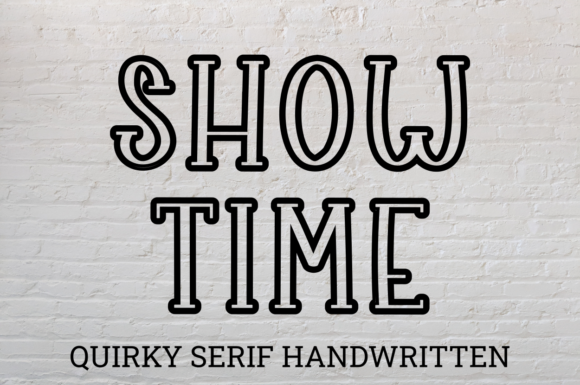
Show Time
When you are staring at a blank canvas, whether it is a digital mockup for a client or a physical poster for a local event, the choice of typography can make or break your design. Most designers know this intuitively, but few truly understand how a single typeface can dictate the entire mood of a project. This is where Show Time enters the conversation. It is not just another font in a crowded library; it is a statement piece designed to be simple, readable, and undeniably bold. If you have been searching for a display font that commands attention without sacrificing clarity, understanding the nuances of Show Time is essential.
Why Simple Bold Fonts Are Often Misunderstood
There is a pervasive myth in the design community that "bold" equals "loud." Many creators assume that to grab attention, they must use overly decorative, intricate, or aggressive typefaces. They pile on shadows, gradients, and distortions, thinking they are adding value. In reality, they often create visual noise that confuses the viewer. This is where Show Time proves its worth as an asset to your font library. Its strength lies in its restraint. It is a display font that relies on clean lines and substantial weight to do the heavy lifting.
The mistake many beginners make is underestimating the power of readability in display typography. A font might look striking in isolation, but if it fails to communicate quickly, it has failed its primary job. Show Time avoids this pitfall by maintaining high legibility even at large sizes. When used correctly, it elevates any creation by providing a solid anchor for your design. However, using it incorrectly can lead to flat, boring, or overwhelming results. The key is recognizing that simplicity requires precision.
The Trap of Overuse and Context Clashes
One of the most common errors when adopting a strong display font like Show Time is applying it everywhere. Because it is so versatile and bold, there is a temptation to use it for body text, subheadings, and logos alike. This dilutes its impact. Display fonts are meant to be displayed, not read paragraph by paragraph. Using Show Time for long-form content will fatigue your reader’s eyes and undermine the professional quality of your work.
Another critical oversight is ignoring context. A font that works beautifully for a music festival poster may feel entirely out of place on a corporate annual report. While Show Time is adaptable, its bold nature demands a specific atmosphere. It thrives in environments that need energy, clarity, and confidence. If you pair it with other competing bold elements, the design will fight itself. You must let Show Time shine by giving it room to breathe. Surrounding it with ample whitespace and simpler supporting fonts allows its character to emerge naturally rather than shouting over other elements.
Evaluating Quality Before You Download
Before you commit to Show Time for a major project, it is vital to evaluate the technical quality of the font file. Not all free or paid fonts are created equal. Some display fonts suffer from poor kerning, inconsistent stroke weights, or limited character sets. These issues become glaringly obvious when you scale the text up for a billboard or down for a mobile notification icon.
To avoid these headaches, check the following before integrating Show Time into your workflow:
- Kerning Pairs: Look closely at combinations like "AV," "To," and "Wa." In a bold display font, tight kerning can cause letters to collide, creating ugly gaps or overlapping shapes. Show Time is generally well-engineered, but verifying this in your specific design software is crucial.
- Weight Variations: Does the family offer multiple weights? A true asset to a font library provides flexibility. If Show Time only comes in one ultra-bold weight, your options for hierarchy are limited. Ensure you have access to lighter variants if available, or plan to pair it with a neutral sans-serif for contrast.
- Ligatures and Special Characters: If your brand uses ampersands, numerals, or currency symbols frequently, ensure Show Time supports them. A missing glyph can ruin the aesthetic cohesion of a logo or price list.
Pairing Strategies That Work
Once you have verified the technical specs, the next step is pairing. A bold display font needs a calm companion. Think of Show Time as the lead singer of a band; you want a rhythm section that holds everything together without stealing the spotlight. A clean, geometric sans-serif or a classic serif works exceptionally well here.
For example, if you are designing a blog header, use Show Time for the title to create immediate visual interest. Then, switch to a highly readable sans-serif like Helvetica or Roboto for the article text. This contrast creates a professional hierarchy that guides the user’s eye. Beginners often try to pair two bold fonts, resulting in a chaotic layout that lacks focus. Remember, the goal is balance. Let Show Time be the star, and let the supporting typography handle the communication.
Practical Applications for Different Audiences
Show Time is not limited to graphic designers. Its utility extends to entrepreneurs, marketers, and educators who need to communicate clearly and effectively. For small business owners, using Show Time on signage or social media graphics can instantly elevate the perceived value of the brand. It signals confidence and professionalism without requiring a complex design budget.
Marketers should pay attention to call-to-action buttons. A bold, readable font like Show Time can increase click-through rates by making the action clear and inviting. However, ensure the background contrast is sufficient. Bold fonts can sometimes lose definition against busy backgrounds. Test your designs in grayscale to ensure the weight holds up without color assistance.
Educators and freelancers can also benefit. When creating presentations or portfolios, Show Time helps structure information visually. It breaks the monotony of standard bullet points and draws attention to key concepts. The trick is moderation. Use it for headers and pull quotes, not for dense data tables. By respecting the font’s limitations, you maximize its potential.
Avoiding Costly Revisions
One of the hidden costs of bad typography is revision time. Clients often reject designs because they "feel off," even if they cannot pinpoint why. Poor font choices are frequently the culprit. By choosing a proven, high-quality display font like Show Time early in the process, you reduce the risk of aesthetic missteps. It saves time, money, and frustration. Instead of spending hours tweaking kerning or searching for a replacement typeface, you can focus on the bigger picture of your creative vision.
In conclusion, Show Time is more than just a font; it is a tool for effective communication. It rewards those who respect its boldness and simplicity. By avoiding common pitfalls like overuse, poor pairing, and neglecting technical checks, you can leverage its potential to elevate any creation. Whether you are a seasoned pro or just starting out, adding Show Time to your toolkit is a smart, practical decision that pays off in every project you undertake.